Category Archives: Weekly Resources

Redos, Retakes, and Do-Overs – Part One

This video is from Rick Wormeli, who wrote Fair Isn’t Always Equal. This book may be my favorite book on assessment and grading, as it covers such a wide range of content, but it does not have to be read cover to cover.

In the video, Wormeli makes a strong case for students being given the opportunity to redo/retake (parts of) assignments/assessments ’till they reach the desired level of proficiency. This approach is in contrast with hard deadlines and students being given only one chance to take a quiz or a test.

Many teachers start the year by working with their students to establish their redo/retake policy (which may then be shared with parents).

How might you give students multiple opportunities to demonstrate their learning?
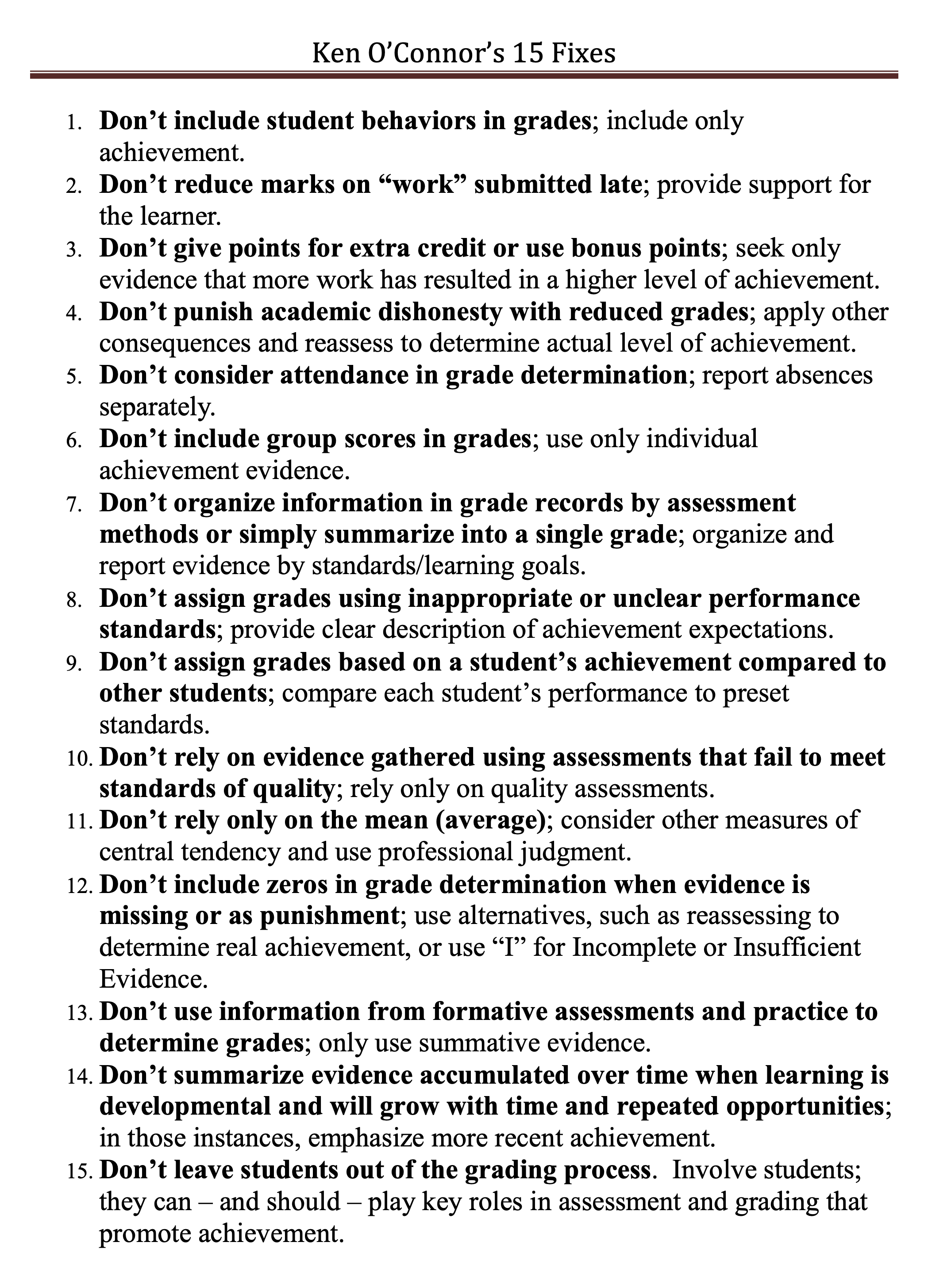
15 Fixes for Broken Grades

See here for a printable version of the above graphic.

The graphic is from A Repair Kit for Grading: 15 Fixes for Broken Grades by Ken O’Connor. This book is one of my favorites as it is a quick read that deals with just the nuts and bolts of standards-based assessment and grading practices. The 15 fixes serve as the basis for the book.

As a classroom teacher, I was never on the receiving end of formal professional development on standards-based assessment and grading practices. It was not until I became an administrator when I decided to educate myself on the topic. As I soon found out, there were glaring discrepancies between my practices and the research in several books on assessment and grading. In fact, I had committed many of the classic mistakes cited in these books: averaging grades, grading group work, forcing students to adhere to strict deadlines when handing in assignments, giving zeros, etc.

I have also found, many educators never receive formal professional development on standards-based assessment and grading practices. But we must educate ourselves beyond our classroom experiences. If we do not, we are doing our students a disservice by potentially grading them the same way we were graded when we were students, which, of course, can be problematic. Looking back, there are several changes I would make to my assessment and grading practices if I were to return to the classroom as a teacher.

What Is Inquiry-Based Learning?

This is a video from John Spencer that beautifully captures what inquiry-based learning is all about. (Spoiler Alert: If you are a Harry Potter fan, you are going to love it.) All of John’s videos are here, and John’s blog is here.

I define inquiry-based learning as students learning through investigation and exploration. Of course, there are many ways to make this happen, and the video provides two frameworks:

And the video provides a few practical ways to get started:

  • A wonder-day or wonder week project where students develop their own questions and move through the inquiry process
  • Genius Hour
  • In math, students exploring a concept and developing their own problems
  • In science, a science fair project or a myth-buster style approach to testing an urban legend

Fly Me to the Moon

This week’s resource is a blog post: Fly Me to the Moon by Jeff Zoul, an administrator from the Chicago area.

This blog post/story helps to illustrate the differences between learning that is hands-on and learning that is minds-on. Ideally, we want learning that is hands-on and minds-on.

For me, the take-home message/quote is:

Although I am a firm believer in engaging students through high-interest activities and projects and using flashy technology tools to enhance such work, I am perhaps even more adamant that these activities, projects, and technologies must relate to specific learning outcomes designed to grow our students’ knowledge and skills.

So, the challenge is infusing creativity into our work while still keeping in mind what students should learn (while also knowing the indicators of student success for any given lesson, activity, unit, etc.).

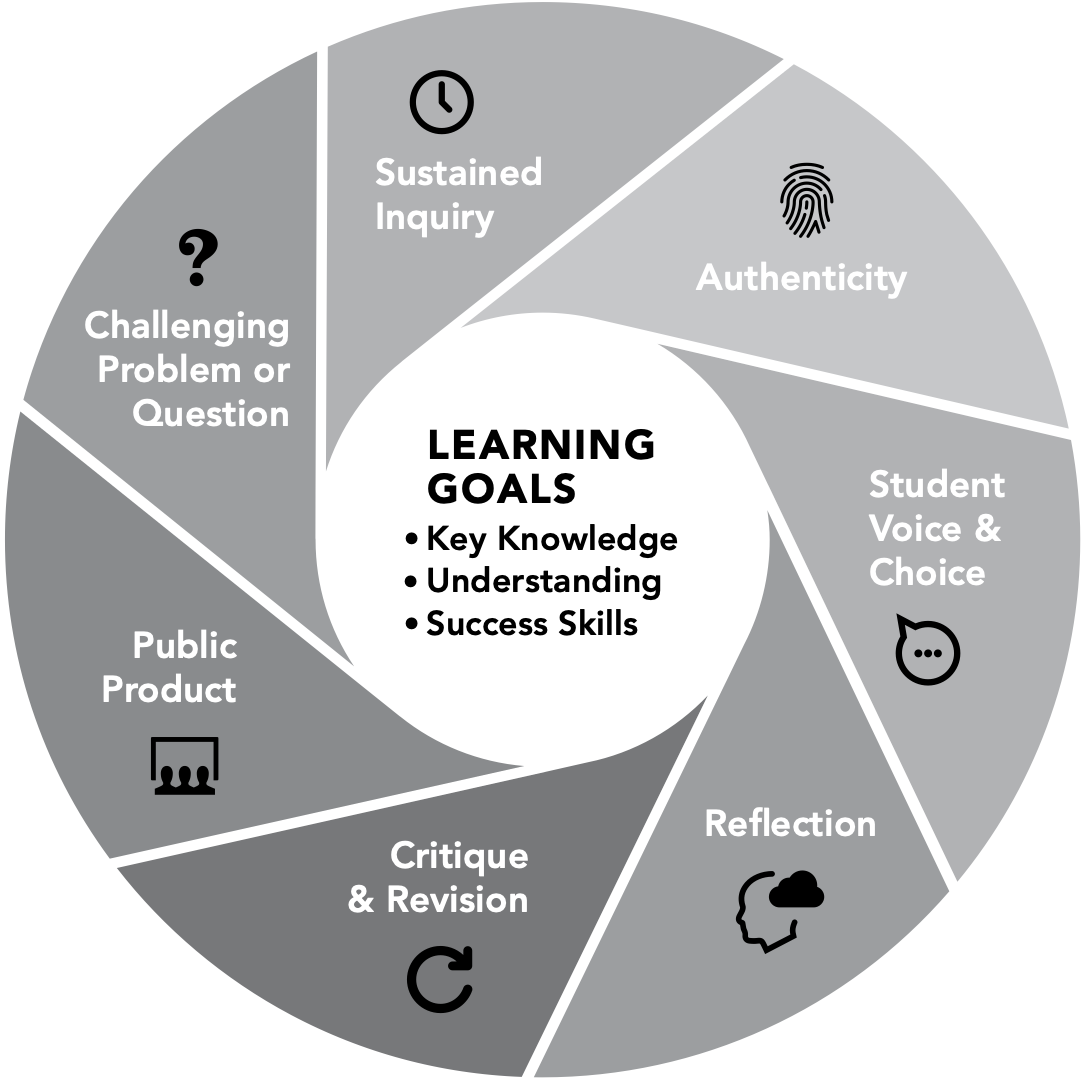
Gold Standard PBL: Essential Project Design Elements

PBLWorks (formerly the Buck Institute for Education) has many resources on project based learning, some of which are better than others. I have always appreciated their essential project design elements (above), which they believe should be a part of every project based learning experience.

This article – Gold Standard PBL: Essential Project Design Elements – has a nice summary of each element. Anyone starting out with project based learning (and some veterans) will probably find the article to be useful. An earlier version of the article was my first go-to resource on the topic. PBLWorks has also created a rubric for the essential elements – Gold Standard PBL: Project Design Rubric – which can help when designing/assessing a project based learning experience.

Of course, when teaching, we do not have to use all of these elements, all the time. We can (start to) incorporate any number of them into our teaching, regardless of whether or not “full-blown” project based learning is the goal.

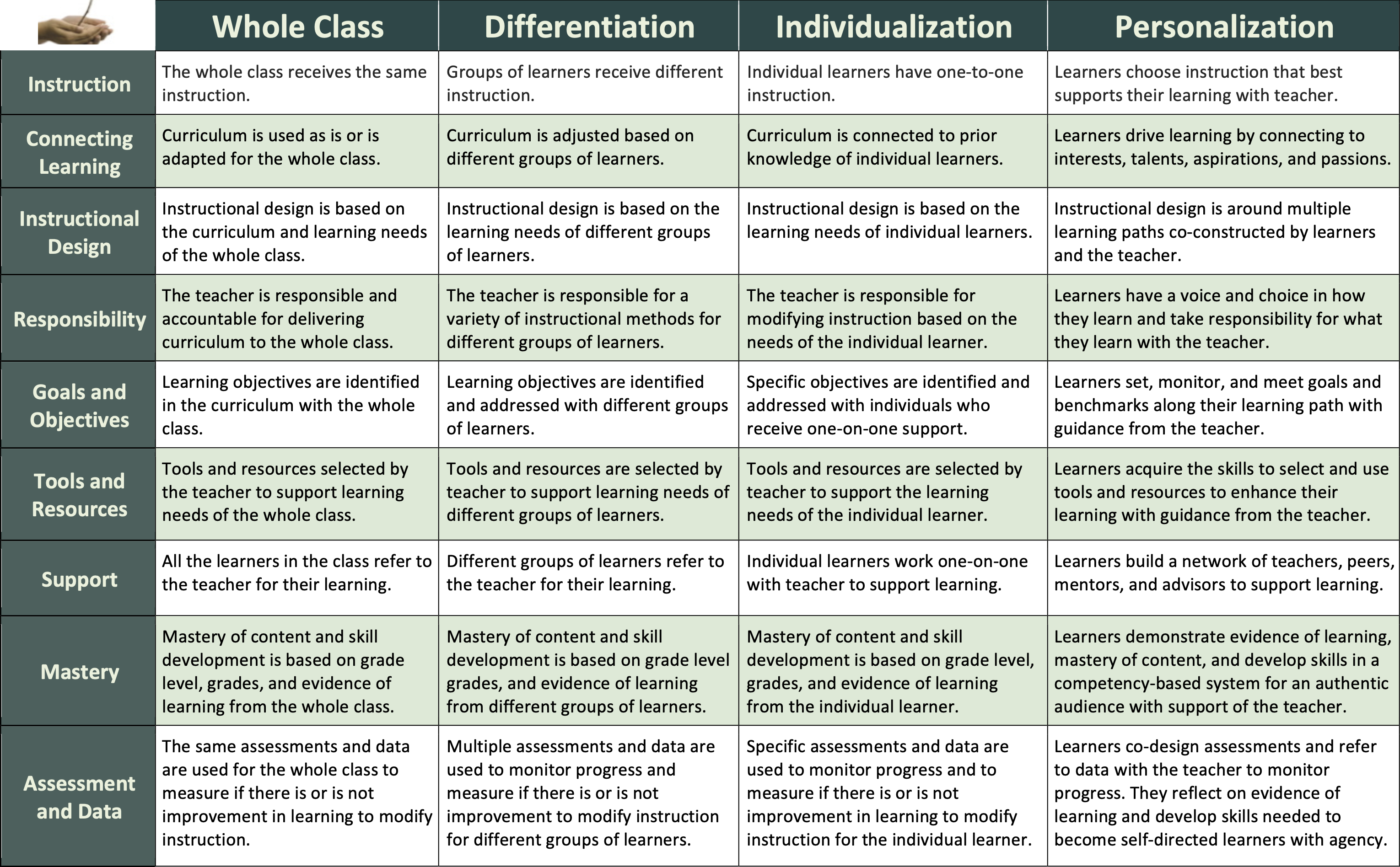
Teaching and Learning Approaches Chart

See here for a printable version of the above graphic.

The graphic was created by Barbara Bray and Kathleen McClaskey, much like the graphic from last week’s post. Bray also wrote this article, which expands upon the graphic.

While the differences between differentiation, individualization, and personalization may at times feel a bit unclear, I think it is worth noting (1) there is in fact a difference between the three, and (2) in one way or another we should always be looking to make our learning spaces and our school more about our students and less about us (moving toward personalization). Again, to make this shift more concrete and obtainable, we can look at the nine elements in the far-left column and think about how we might tackle 1-2 of them.

It is fascinating to think about the extent to which we could push the limits when it comes to students having ownership over what they do in school. And, it is a significant and important shift when discussions and actions go from if we can make it happen to how we can make it happen.

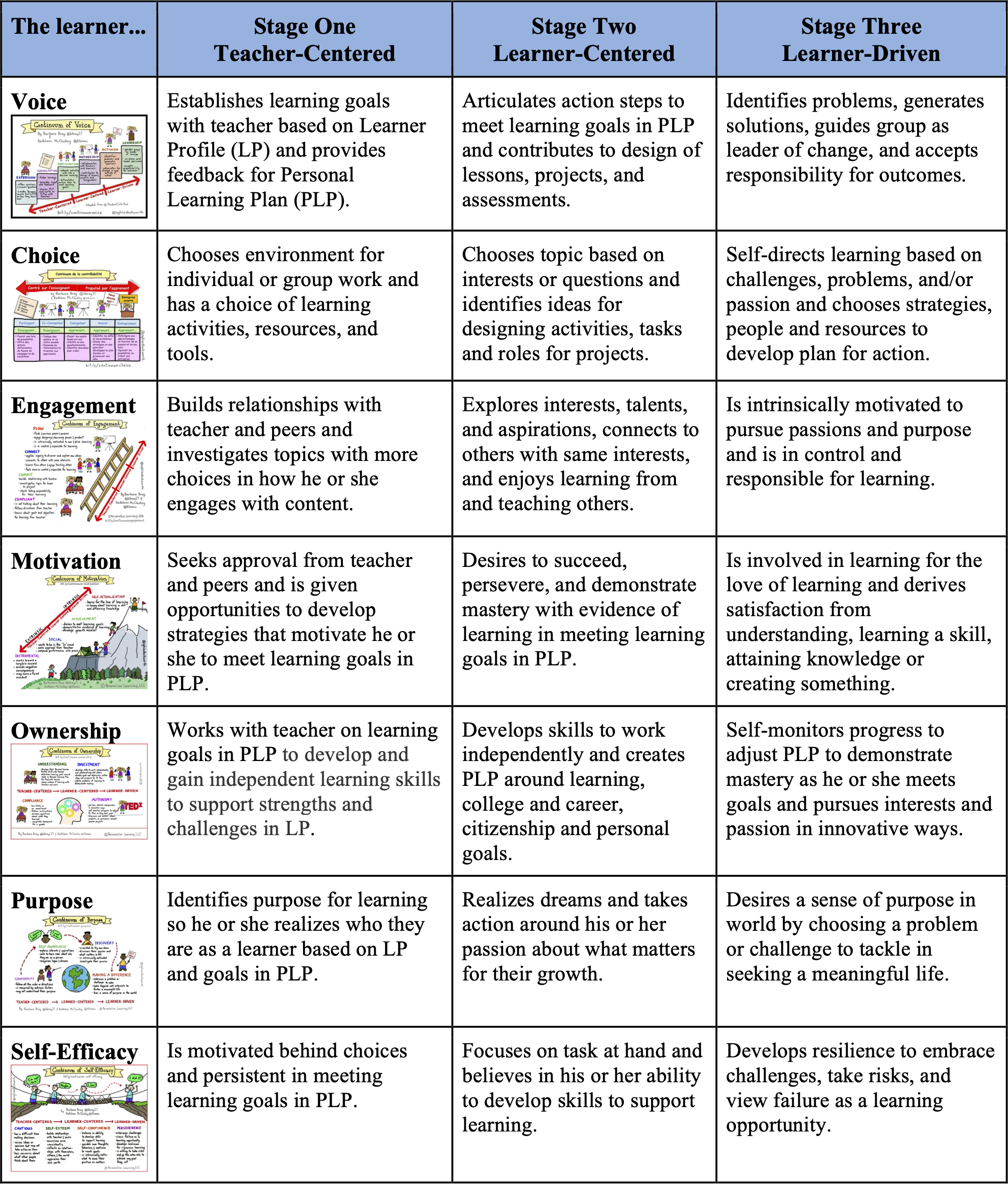
The Elements of Learner Agency

See here for a printable version of the above graphic.

The graphic, created by Barbara Bray and Kathleen McClaskey, is titled Crosswalk of the Elements of Learner Agency Across the Stages of Personalized Learning Environments. It is originally from their book, How to Personalize Learning. I think it nicely compliments Zaretta Hammond’s graphic from last week’s post.

Shifting to a learning space that is learner-centered or learner-driven is not always easy, and it is definitely something with which I struggled as a teacher. When we hear something to the effect of, “You need to move toward student agency,” we may be left wondering what this is and how to make it happen. But, when we look at the elements of student agency and think about how we might tackle 1-2 of them, the idea of student agency feels more concrete and obtainable.

This approach works with more than just student agency, as we can break down pretty much any teaching approach into elements. For example, if we are new to Writing Workshop, rather than trying to master it all in our first year, we can instead prioritize something like mini-lessons, while striving for proficiency with its other elements (conferring, mid-workshop teaching point, share, etc.).

As we promote student-driven experiences, how might we make our learning spaces and our school more about our students and less about us?

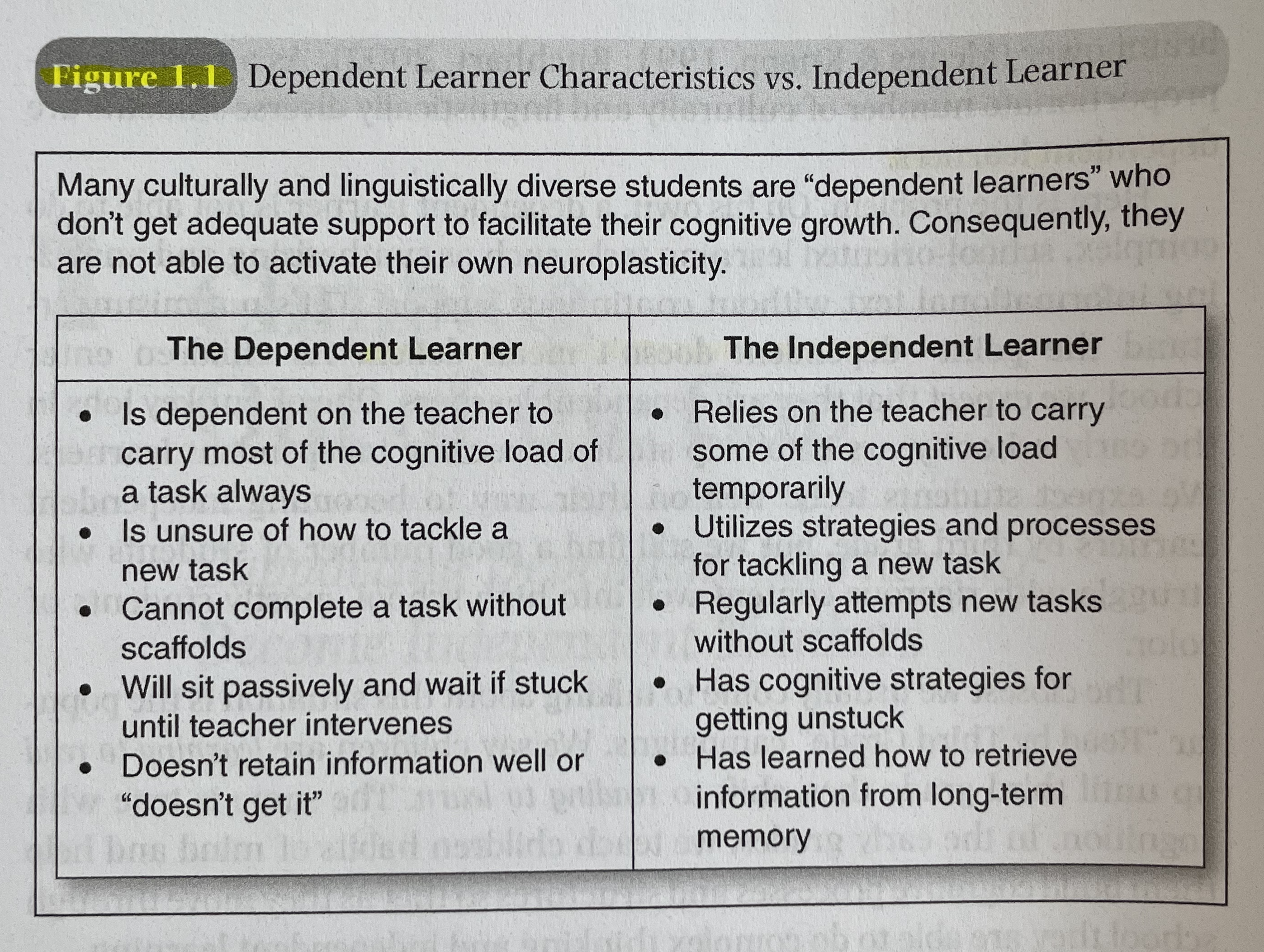
Dependent Learner Characteristics vs. Independent Learner

The graphic is from page 26 of Culturally Responsive Teaching and The Brain by Zaretta Hammond. This a highly recommended book that has been sitting on my bookshelf for awhile, and I just finished reading it.

As it relates to learner agency the difference between dependent learners and independent learners is something for us to think about for all of our students (and for ourselves). And, as we work with students, an essential question we can ask ourselves is: How might we design the conditions for students to move forward in our absence? Or, once instruction is provided and we “walk away” from a student, how can we ensure he or she will continue to learn without having to rely on the teacher?

In my experiences, it is empowering when we shift the conversation from if we can make this happen for all learners to how we can make this happen for all learners.